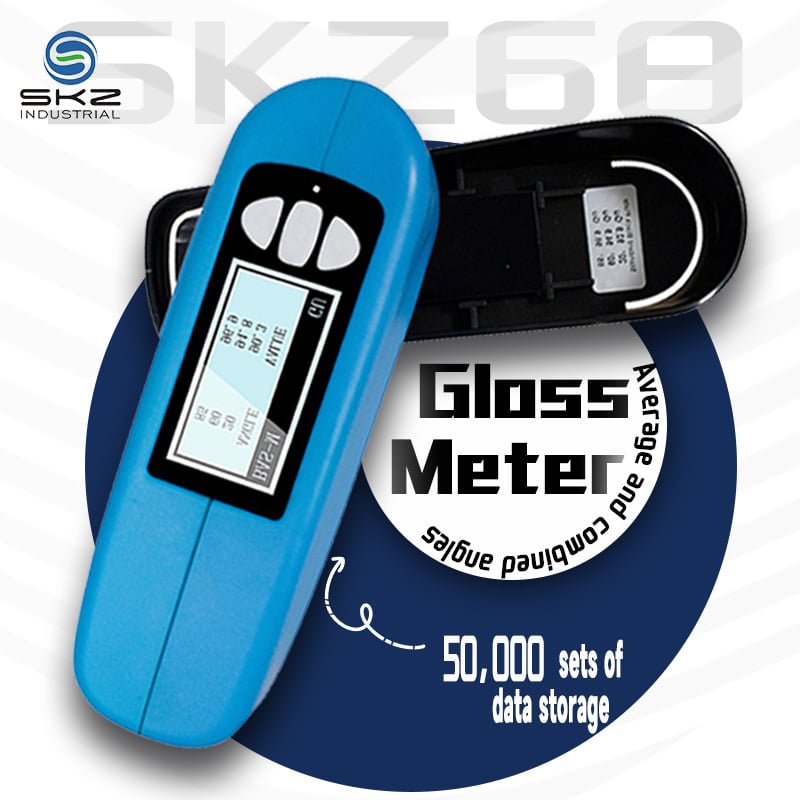
A gloss meter that can measure the quality of a coating, as well as a surface on a piece of material in a controlled and precise way, is necessary in an industrial setting where there is an ongoing need for quality control. A good example of this is the SKZ68 Tri-Angle Gloss Meter, which is considered to be an advanced product that embodies the core values of "Precision + Tri-Angle + Professional." This upgraded version of the SKZ60 has been enhanced to provide more measurement options, allow the operator to choose how to operate the equipment, and provide a greater capability to store and access data from the machine’s memory. It is therefore a perfect solution for the Manufacturer, Quality Inspector, or Material Scientist and Professional in need of accurate and thorough gloss analysis.
Gloss meters have changed significantly since the introduction of the SKZ60, and now users of gloss meters have a 20°/60°/85° 3-Angle Measurement Configuration that allows the measurement of the surface of different types of materials in various gloss levels. The original SKZ60 offered a very small measurement range for various materials of 0-2000Gu = 20° (a perfect range for very shiny surfaces, including polished metals and glossy finishes), 0-1000Gu = 60° (the most widely used angle for nearly all general-use materials), and 0-160Gu = 85° (the range suitable for low gloss and matte-type surfaces, such as matte plastics and textured finishes). With this wide range of measurement capabilities, manufacturers no longer need multiple single-angle gloss meters to measure their products’ gloss levels, and they now have the capability to accurately measure the gloss level of their products from ultra-high gloss to matte finishes.
In addition, the SKZ68 also provides a wide variety of measurement modes that include automatic, manual, single-angle, average, and combined angles. Users can operate in the automatic mode for a quick and easy way to perform measurements (the gloss meter will automatically choose the right angle to use based on the surface's gloss) or in the manual mode for users that would prefer to select the angle(s) to be measured. In addition, the single angle mode allows users to measure at only one angle (20°, 60°, or 85°) based on the material being tested.
 Hot News
 EN
EN