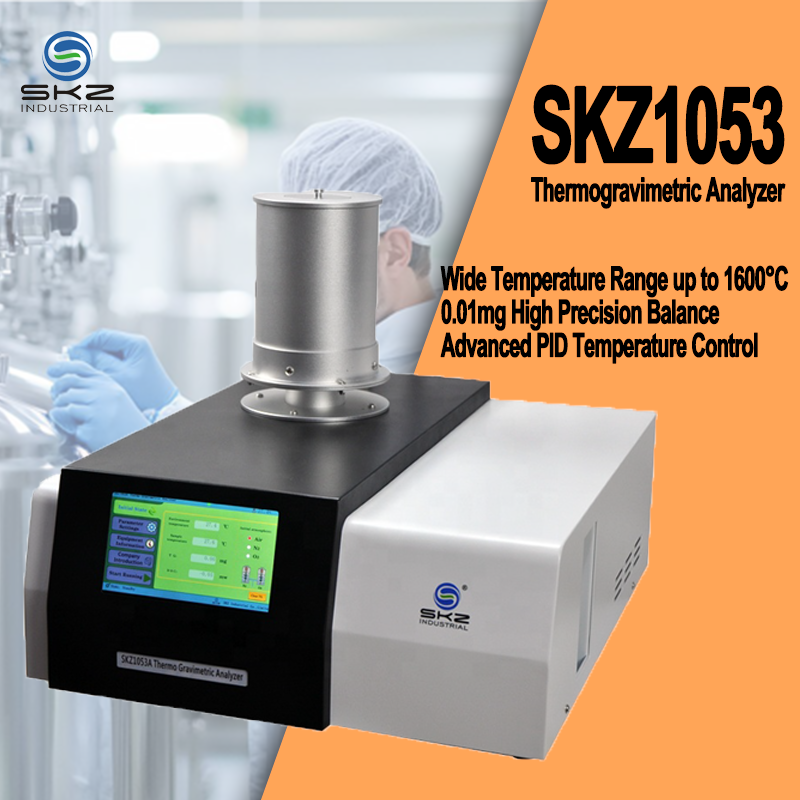
In the realms of research, quality control, and material science, understanding a substance's thermal stability and composition is not just a procedure—it's a cornerstone of innovation and assurance. Thermogravimetric Analysis (TGA) is an indispensable technique that measures the change in mass of a sample as it is heated, revealing critical data on properties like moisture content, volatiles, ash content, and decomposition points. However, the reliability of this data is entirely dependent on the instrument's precision, durability, and ease of use. Many laboratories grapple with TGA equipment that is delicate, difficult to operate, or yields inconsistent results due to environmental interference. Recognizing these challenges, SKZ has engineered the SKZ1053 Thermogravimetric Analyzer—a paradigm shift in thermal analysis that combines robust construction with intelligent software to deliver uncompromising accuracy and operational simplicity. This article will dissect the common hurdles faced by scientists and technicians and illustrate how the SKZ1053 is meticulously designed to overcome them.
Laboratories relying on TGA often encounter a set of persistent and costly problems. A primary issue is the lack of data consistency, frequently caused by temperature fluctuations and external vibrations interfering with the ultra-sensitive microbalance. This leads to unreliable results that can compromise research integrity or quality control standards. Secondly, equipment degradation is a major concern. Standard heating elements and sensors can oxidize or corrode under repeated high-temperature cycles, leading to frequent replacements, downtime, and increased operational costs. Furthermore, cumbersome and risky sample handling is a significant pain point. Traditional side-loading or bottom-loading designs can make it difficult to place samples correctly, often risking damage to the delicate sample rod and causing costly repairs. Lastly, inefficient and complex operation slows down productivity. Non-intuitive controllers, slow data processing, and a lack of remote capabilities can turn a simple test into a time-consuming ordeal. The SKZ1053 Thermogravimetric Analyzer was conceived in direct response to these frustrations, providing a comprehensive solution that addresses each weakness with a decisive strength.
The SKZ1053 from SKZ is not merely an instrument; it is a strategic partner for any laboratory demanding excellence in thermal analysis. It represents a holistic approach to TGA design, where every component, from the core furnace to the user interface, is optimized for performance and longevity. Built to thrive in demanding environments, it ensures that your focus remains on discovery and analysis, not on troubleshooting equipment. The SKZ1053 is distinguished by its dual-pillar advantage: an exceptionally durable and well-thought-out physical structure, and a smart, powerful control system. This synergy guarantees that users receive accurate, repeatable data test after test, while enjoying a streamlined and modern workflow. In the following sections, we will delve into the specific structural and software advantages that make this possible, translating engineering features into tangible benefits for your daily operations.
The physical construction of the SKZ1053 is where its reliability is forged. Each element is designed to mitigate common sources of error and wear.
Double-Row Winding Precious Metal Nickel-Cadmium Alloy Furnace: Unlike conventional heaters, this double-row winding of a precious metal alloy provides uniform and stable heating while significantly reducing electromagnetic interference. This directly tackles the pain point of unstable readings, ensuring that the microbalance is not affected, leading to highly accurate and repeatable TG signals. Furthermore, its superior high-temperature resistance means the furnace can endure long-term, high-heat cycles without degradation.
Precious Metal Alloy Tray Sensor: The sensor is the heart of the TGA, and its failure is a common downtime culprit. The SKZ1053 utilizes a tray sensor made from a specialized precious metal alloy, granting it exceptional resistance to high temperatures, oxidation, and corrosion. This translates to a longer-lasting sensor, reduced maintenance costs, and consistent performance even with aggressive samples.
Separated Power and Circulating Heat Dissipation Unit: One of the most innovative design choices is the physical separation of the power supply and cooling system from the main host. This is a critical feature that solves the dual problems of heat and vibration affecting the micro-thermal balance. By isolating these vibration- and heat-generating components, the SKZ1053 ensures that the most sensitive part of the instrument remains in a stable environment, guaranteeing the integrity of every measurement.
Top-Opening Structure for Effortless Sample Handling: The top-opening design is a user-centric masterpiece. It eliminates the difficulty and risk associated with moving a heavy furnace up or maneuvering a sample into a tight side-port. Placing the sample is now intuitive and straightforward, drastically reducing the chance of accidentally damaging the fragile sample rod—a common and expensive accident in other TGA models. This design saves time and prevents frustration and repair costs.
Integrated Heat Insulation and Customizable Furnace Body: The host system is designed with effective heat insulation that protects the chassis and the critical micro-thermal balance from the extreme temperatures of the furnace. Additionally, the furnace body can be replaced according to specific customer requirements, offering unparalleled flexibility for labs with evolving or specialized testing needs.
While the body of the SKZ1053 is built for endurance, its "brain" is engineered for speed, precision, and ease. The controller and software turn complex procedures into simple, automated tasks.
High-Speed Imported ARM Processor: At the core of the controller is a powerful imported ARM processor. This means faster sampling speeds, rapid data processing, and quicker system response times. For the user, this translates to less waiting and more efficient analysis, allowing a higher throughput of samples without sacrificing data quality.
Four-Channel AD Sampling for TG and Temperature Signals: This feature allows for high-precision, simultaneous collection of the mass change (TG) and temperature (T) data. The multi-channel sampling ensures that both signals are captured with high fidelity and minimal cross-talk, providing a cleaner, more accurate dataset for analysis.
PID Algorithm for Precise Multi-Stage Heating Control: Temperature control is paramount in TGA. The SKZ1053 employs a sophisticated PID (Proportional-Integral-Derivative) control algorithm. This allows for extremely precise ramp rates and stable isothermal holds, enabling complex, multi-stage heating programs. This precision is essential for correctly identifying and separating thermal events that occur close to one another.
USB Bidirectional Communication for Remote Operation: This feature modernizes the laboratory workflow. The instrument and software communicate via a USB interface, allowing for full remote operation. Users can set all instrument parameters, start, stop, and monitor experiments directly from their computer software. This enhances convenience, promotes better data management, and allows for safer operation in environments where it's preferable to be away from the instrument itself.
7-inch Full-Color 24-bit Touch Screen Interface: The days of confusing button-based controllers are over. The SKZ1053 features a vibrant, high-resolution touch screen that provides an excellent human-machine interface. It displays real-time curves and data clearly. Crucially, essential maintenance functions like TG calibration can be performed directly on the touch screen, simplifying what is traditionally a complex manual process and ensuring the instrument remains calibrated with minimal effort.
The robust and precise nature of the SKZ1053 makes it an invaluable asset across a wide spectrum of industries. It is perfectly suited for:
Polymers and Plastics: Analyzing filler content, polymer composition, and thermal stability.
Pharmaceuticals: Determining moisture and solvent content, and studying decomposition profiles of active ingredients and excipients.
Food Science: Measuring fat, moisture, and ash content in food products.
Construction Materials: Evaluating the composition of cement, limestone, and other building materials.
Chemicals and Catalysts: Studying the decomposition behavior and purity of various chemicals and the performance of catalysts.
In conclusion, the SKZ1053 Thermogravimetric Analyzer is a testament to SKZ's commitment to solving real-world laboratory challenges. It is a instrument that doesn't just perform a function; it enhances your entire analytical workflow. By addressing the critical pain points of interference, durability, difficult operation, and data complexity, it empowers researchers and technicians to achieve new levels of productivity and confidence. From its rugged, intelligently separated structure to its smart, user-friendly touchscreen and software, every aspect is designed for excellence. Don't let equipment limitations dictate the quality of your analysis. Invest in the reliability, precision, and efficiency of the SKZ1053. Contact SKZ today to schedule a demo and see how we can transform your thermal analysis outcomes.
 Hot News
 EN
EN