In the era of intelligent food processing driven by trends like sustainability, digitalization, and strict food safety requirements, moisture content control of dried fruits and vegetables has become a core link in ensuring product quality and industrial efficiency. The SKZ111C-4 IoT Smart
Moisture Meter integrates high-frequency sensing technology, durable material design, and intelligent application scenarios to address the pain points of traditional moisture measurement—such as low efficiency, poor accuracy, and difficulty in real-time monitoring. Tailored for vegetables, dehydrated vegetables, and dried fruits, this instrument meets the needs of modern food enterprises for precision testing, process optimization, and quality traceability, becoming an essential "quality sentinel" in the intelligent transformation of the food industry.
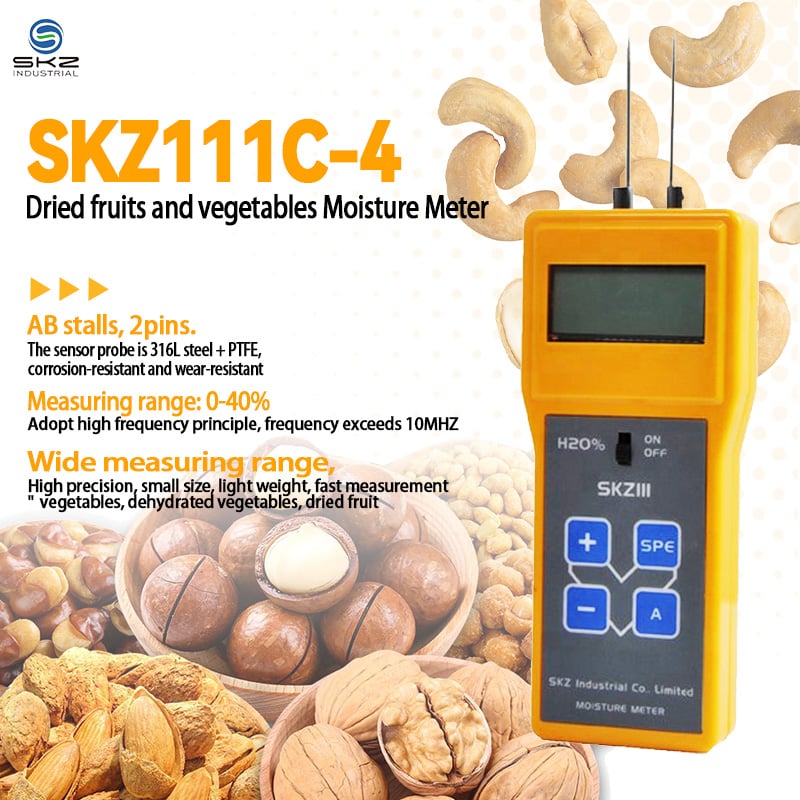
The instrument adopts an advanced high-frequency measurement principle with a working frequency exceeding 10MHZ, which is far more efficient than traditional oven-drying methods. It detects changes in the dielectric properties of water and dry substances in samples to calculate moisture content, enabling non-destructive, rapid measurements in just 1 second. This technology avoids sample damage and environmental interference, ensuring stable data even in complex production environments, and lays the foundation for real-time monitoring of production lines.
The sensor probe is made of 316L stainless steel and PTFE, a combination that ensures excellent corrosion and wear resistance. 316L steel withstands acidic and alkaline components in dried fruits and vegetables, while PTFE (FDA-certified for food contact) has non-stick and anti-contamination properties. This design prevents cross-contamination between samples, simplifies cleaning, and maintains measurement accuracy after long-term use, complying with food safety and hygiene standards.
Equipped with AB stalls and a 2-pin structure, the instrument supports two measurement modes: A-B differential mode and single-ended mode. Differential mode is suitable for samples with uneven moisture distribution, minimizing external interference, while single-ended mode works for uniform or large-batch products. The compact 2-pin probe ensures full contact with samples without damaging delicate materials, adapting to various testing scenarios from production lines to warehouses.
With a measuring range of 0-40%, the instrument covers the moisture needs of most dried fruits (15-25%) and dehydrated vegetables (5-15%). It achieves a precision of ±(0.5%n+1) and 0.1% resolution, meeting strict quality control requirements. Its small size (≈140mm×60mm×24mm) and light weight (≈120g) enable easy portability, supporting on-site testing and mobile inspections, which aligns with the efficient operation needs of intelligent factories.
In dehydrated vegetable and dried fruit production lines, the instrument enables real-time moisture monitoring during drying. It feeds data back to MES systems to dynamically adjust drying temperature and time, reducing energy consumption by optimizing processes—a key step in achieving green and low-carbon production under the "dual carbon" goal.
For finished products, the instrument quickly verifies moisture content compliance before packaging, preventing mold growth or excessive dryness. It supports batch testing and data recording, facilitating quality traceability and meeting regulatory requirements for full-process traceability in the food industry.
In warehouses, the portable design allows staff to spot-check moisture levels of stored products, avoiding spoilage due to environmental humidity changes. This helps reduce waste and ensures the shelf life and marketability of products throughout the supply chain.
The instrument features intuitive operation—users only need to clean the probe, place it in contact with the sample, and get results instantly. Daily maintenance involves wiping the probe with a dry cloth, while monthly calibration with standard samples ensures long-term accuracy. Its rugged design withstands industrial environment wear, reducing maintenance costs for enterprises.
 Hot News
 EN
EN